
What is Sacrificed?
Remember when the title “My Current Situation” was the header du jour for social media posts? Well, it fits well for this recent experience in Marrakech, Morocco
May 26 marked the first full day of Eid Al Adha, a national holiday in Morocco and observed throughout the Islamic world. Offices, banks, schools, and stores close for at least a week, with many people taking up to a month.
This Eid (there are two) is the commemoration of the Prophet Ibrahim’s (Abraham’s) willingness to sacrifice his son Ismail (Ishmael) in obedience to Allah’s (God’s) command. According to the Torah and Bible, Isaac was the son who was to be sacrificed. (We’ll leave that debate to the religious scholars.) However, in all three holy books, the father was given leave to spare his son and sacrifice a ram instead.
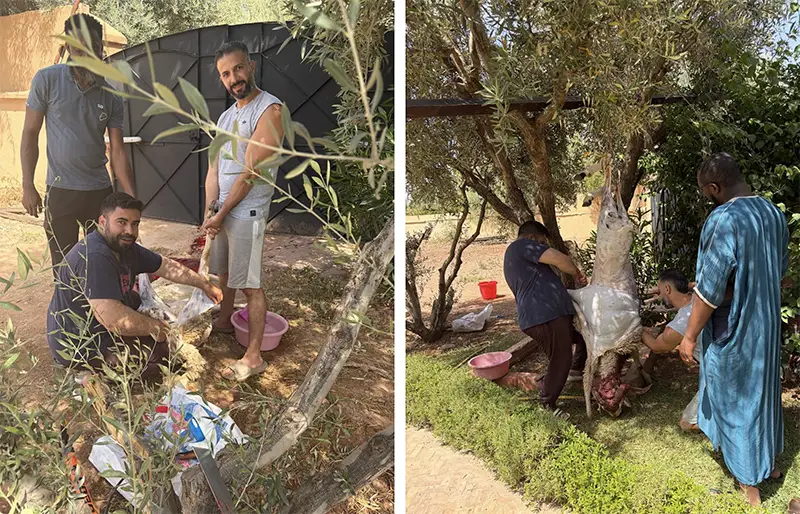
A local Moroccan family came to share the holiday with the people living in and visiting the riad (a traditional Moroccan guesthouse) where I am staying. We were an intrepid group of Americans, Moroccans, Ghanaians, Ivoreans, and Senegalese. Yassin, the head of the family leading the ritual, is also the owner of the transportation company the riad uses for its touring guests.
Yassin led his first family Eid at 18. He and his brothers learned from their father, who learned from his father before him. So, along with partaking in a global ceremony, we were witnessing a legacy passed from father to son, just as the women’s meticulous preparation of the meat was inherited from their mothers.
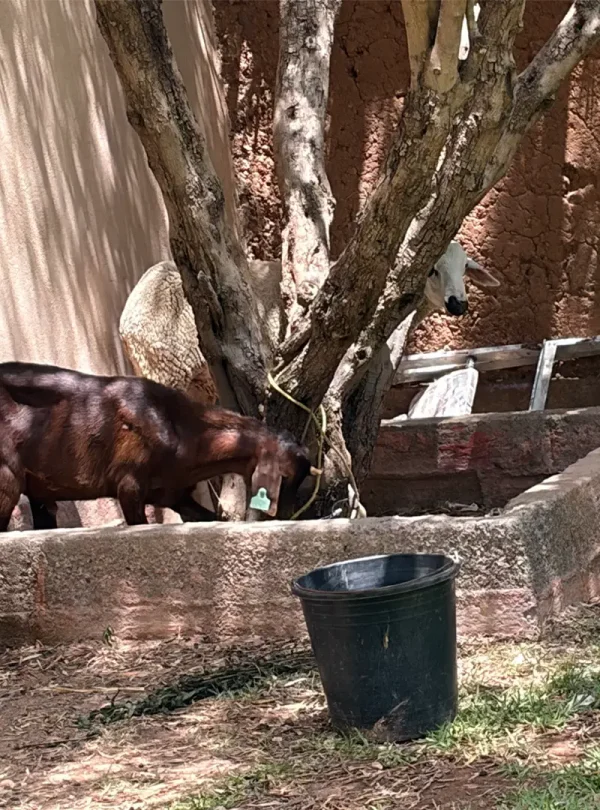
Two days prior, they’d brought three sheep onto the property. Then came the morning they performed the ritual sacrifice, in concert with families in courtyards and on rooftops all over the country.
The sheep’s throat was slit by Yassin and another male family member. The blood was allowed to drain. Then a bicycle pump tube was inserted into the leg, and air was inflated just under the skin until it thumped taut as a drum. This made it easier to shear the fleece with a sharpened knife into a single pelt.
The shearing started with the sheep on the ground, then with the animal hoisted upside down from a tree limb.
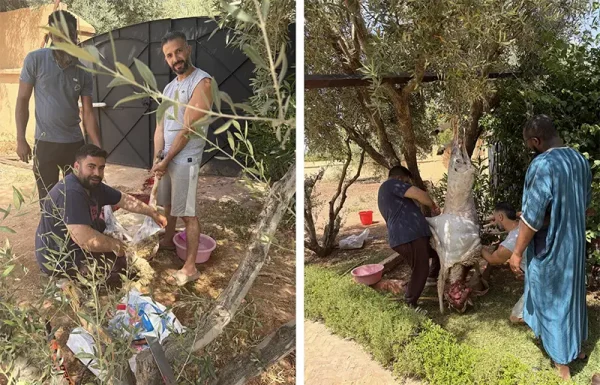
After the fleecing, the women of the family eviscerated the sheep, rinsing the entrails and cavity continuously. These delicacies, along with some of the meat, were then cooked on a grill and served as part of our communal feast.
One-third of the meat was packaged and shared with the broader community, especially the poor. No one goes hungry during Eid and every part of the animal – from meat to hide to wool to bones – has a second life in household, commercial or agricultural use.
This natural process is far removed from the ways in which food usually reaches our tables. For those of us who are not farmers or ranchers, our meat is already apportioned, wrapped in cellophane, and nestled in a long aisle of well-lit, refrigerated display cases.
We have no real connection to the journey from farm to table, and think little of the daisy chain of hands who tend, slaughter, inspect, transport, package, and sell the meat we eat. We seldom review the production process or the accuracy of food labels, to do anything about it should it be discovered that they come up short.
When the request was made of Ibraham/Abraham to sacrifice his son, it was to test his obedience and faith. To see if he would sacrifice his most treasured gift to prove the depth of his spiritual devotion to the Giver.
“The moral underpinning of politics begins with world view.”
Sen. Raphael Warnock
How can we apply this analogously to our current political situation? To me, the basis is to determine our individual and collective perspective, how we look at our place in society in relation to others?
Could we as a nation sacrifice the point of view that being richer and more powerful gives us license to subdue other communities and nations to our will, devoid of any notion of what is for the common good?
How about our insistence on always being right in our interactions with others? Or our intrenchable judgment of others that leaves no sliver of space for the benefit of the doubt, no inkling that we might be wrong?
Could we question the appearance our clout-chasing status symbols bestow upon us – what we drive, what labels we wear, the books on our shelves, the size, location, or number of our homes, where we vacation, the prestige of the schools we attended, and the exclusivity of our clubs?
What do we risk by putting down our phones for an hour or a day and letting the inevitable discomfort be the portal to the gifts of profound quiet, heightened creativity, and deeper insight into the world around and within us?
I imagine Abraham/Ibrahim wrestled mightily within himself before coming to his decision to acquiesce to what was asked of him. Our own allegiance to material attachments, certainty, and ego will not be relinquished without a knock-down, drag-out fight, their vestiges clinging like the frantic death throes of the sheep.
Much of the evil in this world is due to the fact that man, in general, is hopelessly unconscious.”
Carl Jung
Yet every movement that has expanded human freedom has demanded sacrifice. The people we now celebrate as heroes of the civil rights movement gave up comfort, security, opportunity, reputation, and sometimes even their lives in pursuit of a larger vision of human dignity. Looking back, their choices seem obvious. Living through them, they were anything but.
Which raises a question for our own time: What are we willing to sacrifice—not merely for ourselves, but for one another? For the common good? For a more just and humane society? The answer may tell us who we are. More importantly, it may reveal who we are capable of becoming.
Even the mere act of asking the question and sitting in the haze of not yet knowing the answer has life-changing value.
March On!
