Thank you for an unforgettable 2026 festival. Support the movement this giving season.

Nations of Ignorant Savages

“It would be a very strange Thing, if six Nations of ignorant Savages should be capable of forming a Scheme for such an Union, and be able to execute it in such a Manner, as that it has subsisted Ages, and appears indissoluble; and yet that a like Union should be impracticable for ten or a Dozen English Colonies, to whom it is more necessary, and must be more advantageous…”

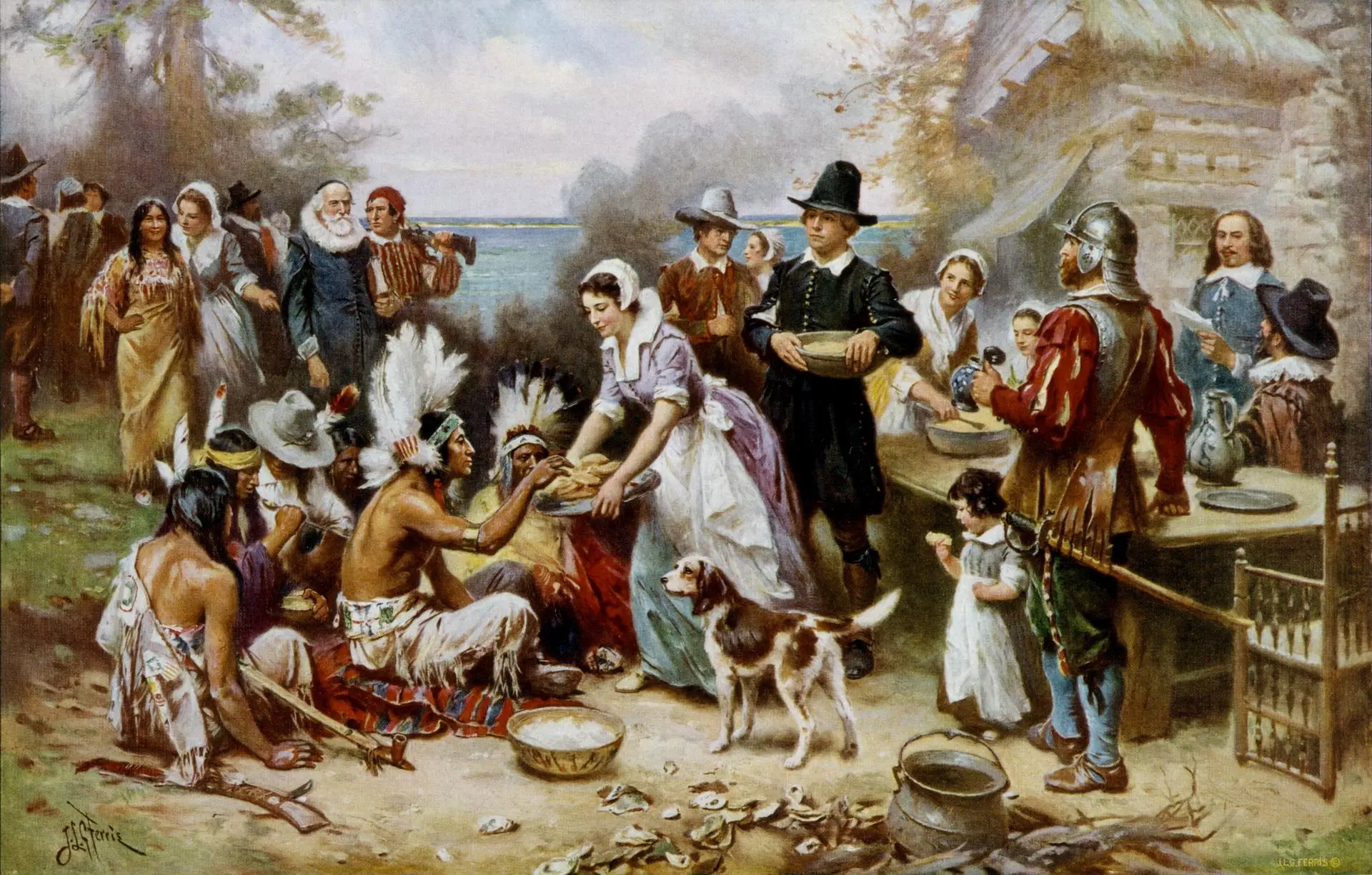
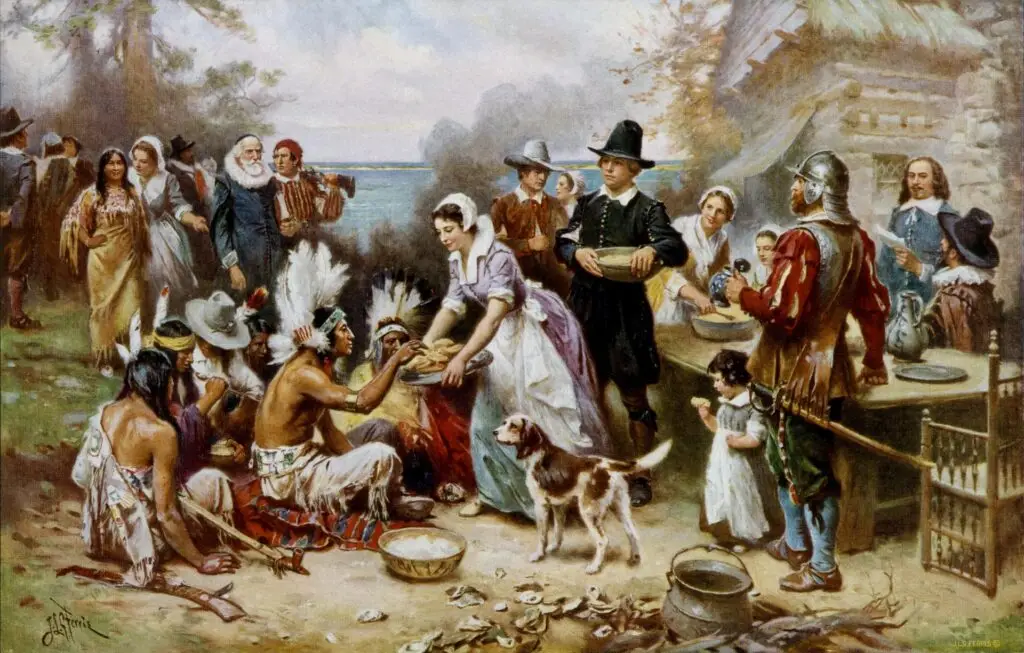
Do you remember the elementary school Thanksgiving assemblies from years past? Young students cosplayed an imagined harvest celebration circa 1621 in Plymouth, Massachusetts. Pilgrim men in black hats and women in white aprons. Indians with feathered headdresses and buckskin clothing emerging from the surrounding woods to share a communal table of provisions. 

Myth of the First Thanksgiving

So much fantasy and myth surrounds depictions of this gathering which actually was not known as the  “first” Thanksgiving until decades later. The few dozen Pilgrims remaining from those who’d originally landed from England in 1620, were grateful to have survived disease, weather, hostilities and deprivation in a strange land. They could not have done so without the help of native inhabitants in the area, the Wampanoag Nation with whom the Pilgrims had formed tenuous alliances.  

These were not the first Europeans the Wampanoag had seen, hence their wariness. And rightly so, for within a generation, the Wampanoag would lose their land and political sovereignty. For Indigenous Americans and all those who acknowledge the real history, Thanksgiving masks a day of mourning and deep reflection on the harmful stereotypes and distorted history that predominates the holiday.

The Haudenosaunee AKA Iroquois Confederacy

Another critical example of the relationship between Indigenous inhabitants and colonists, this time in the upper New York state, Pennsylvania, parts Ohio, Ontario and Quebec, is the role of the powerful Iroquois Confederacy in the founding of the United States.  

Originally composed of five nations – Mohawk, Oneida, Onondaga, Cayuga and Seneca – they called themselves the Haudenosaunee, meaning People of the Long House. A sixth nation, the Tuscarora, joined in 1722.

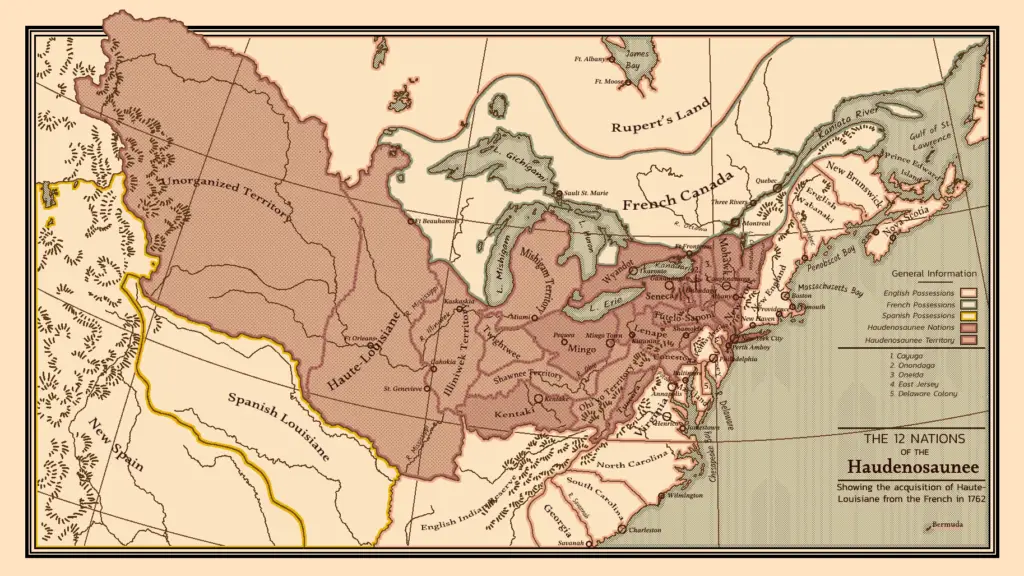
Haudenosaunee or Iroquois territory, long before the 13 colonies.

It is known as one of the world’s oldest participatory democracies, with its origins traced to between 1570  and 1600. Its purpose was to advance “peace, civil authority, righteousness, and the great law” as a means of standing together against invasion.

Leaders were:

  • Bound by an oral constitution and consensus based governance.
  • The Grand Council of 50 peace chiefs or sachem, each with one vote, addressed all civil issues at the intertribal level.
  • Each nation maintained control of its own internal affairs
  • Leaders had to consider how their current decisions, laws, and actions would impact the next seven generations.


Iroquois decision-making was so organized, colonialist governments used its system in their joint negotiations. Their model of individual “states” under a larger “federal” union served as an inspiration to the framers of the American constitution and was the basis for Ben Franklin’s 1754 Albany Plan of Union to unite the 13 colonies. 

There was one other defining feature in Iroquois governance:

  • Clan Mothers, through whom lineage, identity and property were traced, were the matrilineal leaders and had the power to appoint or remove chiefs.  
  • This part of Iroquois’ leadership framework did not carry over to the US model.

The Iroquois Confederacy Today

The Onondaga, Seneca, and Tuscarora, as well as some Oneida, remained in New York, eventually settling on reservations. The Mohawk and Cayuga withdrew to Canada. A generation later, a large group of the Oneida departed for Wisconsin, with still others settling in Ontario, Canada. 

On October 21, 1988, a joint resolution of the U.S. Congress and Senate formally acknowledged that the framing of the Constitution and the Bill of Rights were modeled in part on the democratic principles of the Iroquois Confederacy.  

The Six Nations continue to have sovereign nation-to-nation relationships with the US under federal law.

Note:
The Seneca Nation, part of the Iroquois Confederacy and the largest tribe in New York state, has elected Tina Abrams as its first woman president in modern history. Although they are a matrilineal society where women have traditionally wielded power, women were barred from voting from the 1848 constitution to the 1960s.

Sources: Pilgrim Hall Museum.com; Library of Congress Blog, September 2023; Britannica; Pennsylvania Gazette, January, 2007; History.com, November, 2020.

March On!

March On!
Privacy Overview

This website uses cookies so that we can provide you with the best user experience possible. Cookie information is stored in your browser and performs functions such as recognising you when you return to our website and helping our team to understand which sections of the website you find most interesting and useful.